Standard Essay Format: MLA, APA, Chicago Styles

Sourav Mahahjan
Feb 10, 2026
Writing a university essay is not just about presenting strong arguments — it’s also about formatting your work correctly. Academic institutions require students to follow standardised citation and formatting styles to maintain clarity, credibility, and academic integrity.
If you’ve ever wondered:
• What is MLA format?
• What is APA format?
• What is Chicago style citation?
• Which essay format should I use?
• How do I format references correctly?
This comprehensive guide will explain everything you need to know about Standard Essay Formats: MLA, APA, and Chicago Style, so you can submit polished, properly formatted academic papers with confidence.
Why Essay Formatting Matters in Academic Writing
Before we dive into the formats, let’s understand why formatting is so important.
Proper essay formatting:
• Ensures academic credibility
• Prevents plagiarism
• Makes your research traceable
• Improves readability
• Helps professors evaluate work efficiently
Universities worldwide use standardised citation styles to maintain consistency in scholarly communication. The three most common formats are:
1. MLA Format (Modern Language Association)
2. APA Format (American Psychological Association)
3. Chicago Style (Chicago Manual of Style)
Each format has specific rules for structure, citations, references, headings, and layout.
1. MLA Format (Modern Language Association)
What Is MLA Format?
MLA format is widely used in humanities disciplines, including:
• Literature
• English
• Philosophy
• Cultural Studies
• Arts
If you’re writing a literary analysis or research paper in English class, you’re most likely required to use MLA format.
Key Features of MLA Format
1. General Formatting Guidelines
• Font: Times New Roman, 12-point
• Double-spaced
• 1-inch margins on all sides
• Header with last name and page number (top right corner)
• Left-aligned text
• Indent first line of each paragraph
2. MLA Heading Format
In MLA style, the heading appears on the first page and includes:
• Your Name
• Instructor’s Name
• Course Name
• Date (Day Month Year format)
Example:
John Smith
Professor Mary
English 201
10 February 2026
MLA In-Text Citation Format
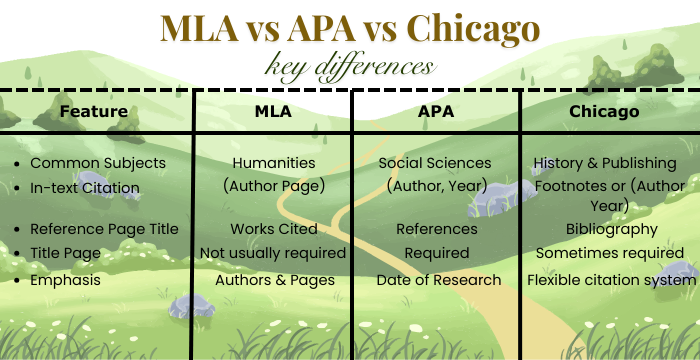
MLA uses author-page format for in-text citations.
Example:
“Education is the most powerful weapon” (Mandela 45).
If the author’s name is mentioned in the sentence:
Mandela argues that education transforms society (45).
MLA Works Cited Page
The reference page is called “Works Cited.”
Format:
Author’s Last Name, First Name. Title of Book. Publisher, Year.
Example:
Smith, John. The Art of Academic Writing. Oxford University Press, 2022.
When to Use MLA Format
Use MLA style when:
• Writing literary analysis essays
• Studying humanities subjects
• Analysing poems, novels, or films
2. APA Format (American Psychological Association)
What Is APA Format?
APA format is commonly used in:
• Psychology
• Sociology
• Education
• Nursing
• Business
• Social Sciences
APA is one of the most searched academic formatting styles because many university students across disciplines are required to use it.
Key Features of APA Format (7th Edition)
1. General Formatting Rules
• Font: Times New Roman (12 pt), Arial (11 pt), or Calibri (11 pt)
• Double-spaced
• 1-inch margins
• Page number in the top right corner
• Title page required
APA Title Page Format
An APA paper includes:
• Paper title (bold and centred)
• Author name
• University name
• Course name
• Instructor name
• Due date
APA emphasises clarity and professional presentation.
APA In-Text Citation Format
APA uses the author-date format.
Example:
Education improves social mobility (Mandela, 1994).
If directly quoting:
“Education is the most powerful weapon” (Mandela, 1994, p. 45).
APA Reference Page
The reference page is titled “References.”
Format:
Author, A. A. (Year). Title of work. Publisher.
Example:
Smith, J. (2022). The art of academic writing. Oxford University Press.
When to Use APA Format
Use APA style when:
• Writing research papers in psychology
• Submitting lab reports
• Conducting social science research
• Writing education-related essays
3. Chicago Style Format (Chicago Manual of Style)
What Is Chicago Style?
Chicago style is commonly used in:
• History
• Journalism
• Publishing
• Theology
• Fine Arts
Chicago offers two citation systems:
1. Notes and Bibliography (NB) – Used in the humanities
2. Author-Date – Similar to APA, used in sciences
Chicago Notes and Bibliography Style
This style uses footnotes or endnotes instead of in-text citations.
Example of a footnote:
1. John Smith, The Art of Academic Writing (Oxford: Oxford University Press, 2022), 45.
The reference page is called a Bibliography.
Chicago Author-Date Style
This version uses parenthetical citations:
(Smith 2022, 45)
The reference list is titled References, similar to APA.
General Chicago Formatting Guidelines
• Double-spaced
• 1-inch margins
• Page numbers
• Title page may be required
• Bibliography at the end
Common Formatting Mistakes Students Make
Even strong essays lose marks due to formatting errors. Avoid these common mistakes:
• Incorrect in-text citations
• Missing reference entries
• Wrong indentation
• Incorrect capitalisation in titles
• Not double-spacing
• Mixing citation styles
Always double-check formatting guidelines before submission.
Pro Tips to Master Essay Formatting
Here are some practical academic writing tips:
1. Use Citation Generators (But Review Them)
Online citation tools can help, but always manually check formatting.
2. Download Official Style Guides
Refer to:
• MLA Handbook
• APA Publication Manual (7th edition)
• Chicago Manual of Style
3. Use University Writing Centres
Many universities provide formatting templates.
4. Create a Formatting Checklist
Before submission, confirm:
• Margins
• Spacing
• Font
• Citation accuracy
• Reference page consistency
Why Understanding Citation Styles Improves Academic Writing
Learning MLA, APA, and Chicago style isn’t just about rules. It improves:
• Research credibility
• Logical organisation
• Academic professionalism
• Plagiarism prevention
• Critical thinking
Strong formatting reflects strong academic discipline.
Frequently Asked Questions (FAQs)
- Is MLA easier than APA?
MLA is often considered simpler because it doesn’t require a title page and uses page numbers instead of publication years.
- What is the latest APA edition?
Currently, most universities follow the APA 7th edition.
- Can I use footnotes in APA?
APA primarily uses parenthetical citations, not footnotes, for references.
- Is Chicago style the same as Turabian?
Turabian is a simplified version of the Chicago style, commonly used by students.
Final Thoughts: Mastering Standard Essay Formats
Understanding Standard Essay Formats: MLA, APA, and Chicago is essential for academic success. Proper formatting demonstrates professionalism, prevents plagiarism, and strengthens your credibility as a student researcher.
Instead of viewing formatting as a burden, see it as a tool that enhances your academic voice.
The more comfortable you become with citation styles, the more confident and efficient your essay writing process will be. If you regularly write academic essays, bookmark this guide and refer to it whenever you need clarity on formatting rules.
Academic excellence isn’t just about ideas — it’s also about presentation.