Self editing checklist in Essay

Sourav Mahahjan
Feb 16, 2026
Writing an essay is only half the job. The real magic happens during self-editing. Whether you are a school student, university scholar, or competitive exam aspirant, mastering the self-editing checklist in essay writing can dramatically improve your grades and academic confidence.
In this detailed guide, you will learn:
• What self-editing means in essay writing
• Why self-editing is important
• A complete self-editing checklist
• Practical editing tips for students
• Common essay mistakes to avoid
If you’ve been searching for “how to edit an essay,” “essay editing tips,” “self-editing checklist for students,” or “how to improve essay writing,” this guide is for you.
What Is Self-Editing in Essay Writing?
Self-editing is the process of reviewing and revising your own essay before submission. It involves checking:
• Content clarity
• Structure and organisation
• Grammar and punctuation
• Spelling errors
• Formatting requirements
Unlike proofreading, which mainly focuses on surface-level errors, self-editing goes deeper. It ensures your essay is clear, logical, persuasive, and academically strong.
Why Is Self-Editing Important?
Many students lose marks not because they lack knowledge, but because of avoidable mistakes. A strong self-editing process helps you:
• Improve clarity and coherence
• Strengthen arguments
• Remove repetition
• Fix grammar mistakes
• Enhance vocabulary
• Meet academic formatting standards
Professors appreciate essays that are polished and well-structured. A carefully edited essay reflects professionalism, critical thinking, and attention to detail.
The Ultimate Self-Editing Checklist in Essay Writing
Here is a complete, step-by-step self-editing checklist you can use before submitting any essay.
1. Check the Essay Structure
Start by reviewing the overall structure.
Introduction
• Does your introduction clearly introduce the topic?
• Is the background information relevant?
• Is the thesis statement clear and specific?
• Does it outline the main argument?
A strong thesis statement is the backbone of effective academic writing.
Body Paragraphs
• Does each paragraph focus on one main idea?
• Is there a clear topic sentence?
• Are arguments supported with evidence or examples?
• Are transitions smooth between paragraphs?
Each body paragraph should follow a logical flow:
Topic Sentence → Explanation → Evidence → Analysis → Conclusion Sentence
Conclusion
• Does the conclusion summarise key points?
• Does it restate the thesis differently?
• Does it provide closure without introducing new ideas?
2. Check Clarity and Coherence
Clarity is essential in essay writing.
Ask yourself:
• Are sentences clear and easy to understand?
• Have you avoided overly complex sentences?
• Are ideas logically connected?
• Have you removed unnecessary words?
Pro Tip:
Read your essay aloud. If you stumble while reading, your reader likely will too.
3. Check Grammar and Sentence Structure
Grammar mistakes can significantly reduce your marks.
Look for:
• Subject-verb agreement errors
• Incorrect verb tenses
• Run-on sentences
• Sentence fragments
• Misplaced modifiers
Common Example:
Incorrect: The results shows significant improvement.
Correct: The results show significant improvement.
Using grammar-checking tools can help, but never rely on them completely.
4. Check Vocabulary and Word Choice
Strong vocabulary enhances essay quality, but avoid overcomplicating.
Ask:
• Have you avoided informal language?
• Are there repetitive words?
• Have you replaced vague words like “things,” “stuff,” or “a lot”?
Instead of:
• “A lot of problems” → “Numerous challenges”
• “Very important” → “Crucial” or “Significant”
Academic writing should be formal, precise, and objective.
5. Check Evidence and Citations
If you’re writing an academic essay, evidence is crucial.
• Are all claims supported by examples, data, or references?
• Have you cited sources properly?
• Are you following the required format (MLA, APA, Chicago)?
If your institution requires formatting styles like MLA, APA, or Chicago Manual of Style, double-check:
• In-text citations
• Reference list formatting
• Page numbers
• Font style and size
Incorrect citation formatting can cost valuable marks.
6. Check Paragraph Flow and Transitions
Transitions improve readability.
Check if you have used linking words such as:
• However
• Furthermore
• In contrast
• Similarly
• Therefore
• Consequently
Poor transitions make essays feel disconnected. Smooth transitions create coherence and logical progression.
7. Check Word Count and Relevance
• Have you met the required word limit?
• Is every paragraph relevant to the topic?
• Have you removed unnecessary repetition?
If your essay exceeds the word limit, trim redundant explanations without removing key arguments.
8. Check Formatting Guidelines
Formatting matters more than many students realise.
Verify:
• Font style (e.g., Times New Roman)
• Font size (usually 12)
• Line spacing (double-spaced if required)
• Margin settings
• Title page format (if required)
• Page numbers
Even a well-written essay can lose marks due to formatting negligence.
9. Check for Plagiarism
Originality is essential in academic writing.
• Have you paraphrased properly?
• Have you credited all sources?
• Have you avoided copying directly without quotation marks?
Plagiarism can lead to severe academic consequences. Always ensure your essay is original and properly cited.
10. Final Proofreading Round
After editing content and structure, perform a final proofreading check.
Focus on:
• Spelling mistakes
• Typographical errors
• Missing punctuation
• Capitalisation errors
Take a short break before this step. A fresh mind spots mistakes more effectively.
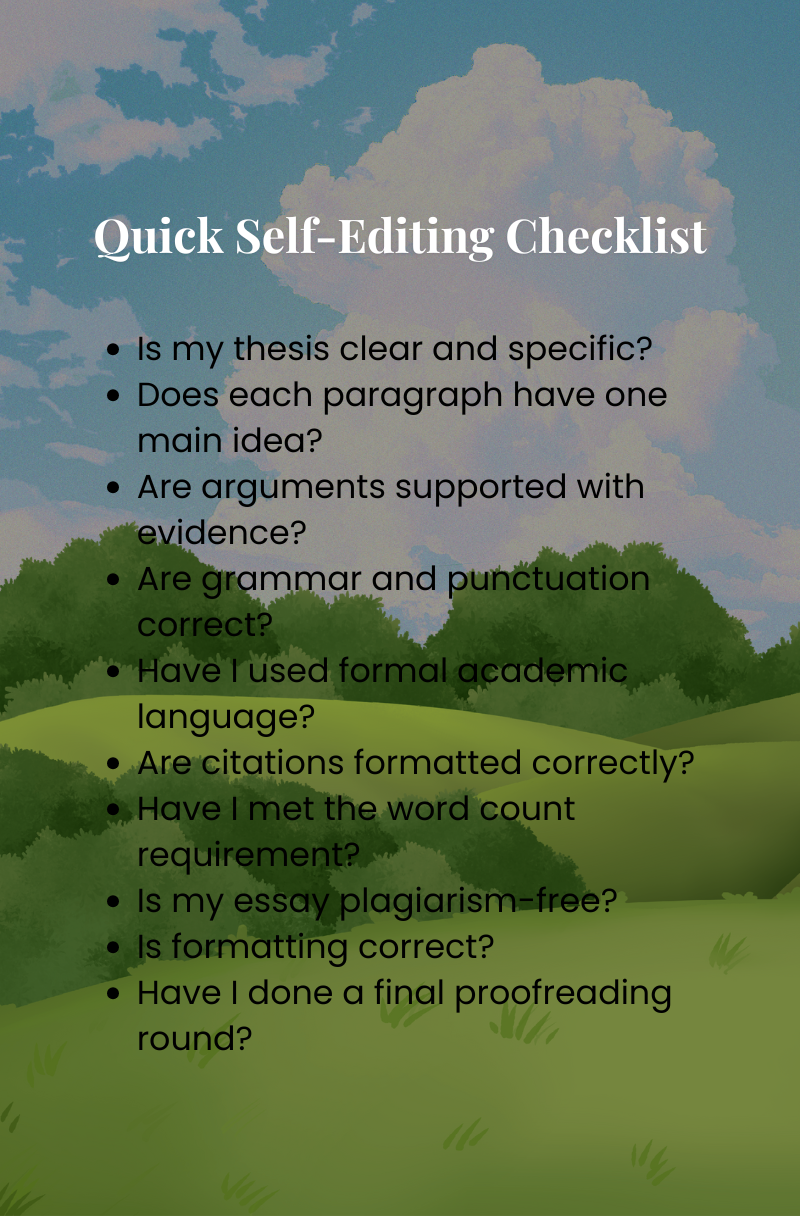
Fig: Self-Editing Checklist (Quick Reference)
Common Essay Mistakes Students Make
To improve essay writing skills, avoid these common mistakes:
• Weak thesis statement
• Lack of evidence
• Overuse of passive voice
• Repetition of ideas
• Informal language
• Ignoring assignment instructions
Awareness is the first step toward improvement.
Practical Self-Editing Tips for Students
Here are some expert editing tips that can instantly improve your essay quality:
1. Take a Break Before Editing: Never edit immediately after writing. Wait at least 30 minutes or a few hours.
2. Edit in Multiple Rounds: Don’t check everything at once.
• Round 1: Structure
• Round 2: Content clarity
• Round 3: Grammar
• Round 4: Proofreading
3. Print Your Essay (If Possible): Reading on paper helps identify mistakes you might miss on screen.
4. Use the Reverse Reading Technique: Read your essay sentence by sentence from bottom to top to catch grammar errors.
5. Ask: “Does This Add Value?”: If a sentence doesn’t strengthen your argument, remove or revise it.
How a Self-Editing Checklist Improves Academic Performance
Students who consistently use a self-editing checklist in essay writing often experience:
• Higher grades
• Stronger writing confidence
• Improved critical thinking
• Better academic discipline
• Reduced last-minute stress
Self-editing transforms an average essay into an excellent one.
Final Thoughts
Mastering the self-editing checklist in essay writing is one of the most powerful academic skills a student can develop. Writing is rewriting. The difference between a good essay and an outstanding one lies in the editing process.
If you want to improve essay writing skills, score higher in university assignments, and produce professional-quality academic work, make self-editing a non-negotiable habit.
Remember:
First draft = You telling yourself the story.
Final draft = You telling the reader the story clearly and effectively.
Start using this checklist today and transform your academic writing journey with theassignmentninjas.