Primary vs Secondary Research

Sourav Mahahjan
Dec 22, 2025
Research is the backbone of any high-scoring university assignment, research work, and dissertation. Although a large number of students face a fundamental challenge: “Should I use primary research or secondary research—and how do I conduct them correctly?”
If you are also a university student looking to strengthen your arguments, achieve high grades, and produce highly credible academic work, the following blog will guide you through primary and secondary research, providing clear methods, examples, advantages, and strategies to utilise.
What is Research in academic writing?
Academic research is the process of collecting, analysing, and evaluating the data systematically to answer the research questions. The universities generally consider two different types of research:
Primary Research: Data collected by the student himself
Secondary Research: Data collected by others and that are already published
Understanding the following difference is very significant for case studies, dissertations, assignments, and journal papers.
What is primary research?
Primary Research is the original data collected for the first time by the researcher for a particular work.
Some of the standard primary research methods
1. Survey and Questions
- Online (Google Forms, SurveyMonkey)
- Paper-based
- Used for quantitative analysis
2. Interviews
- Structured, semi-structured, or unstructured
- Ideal for qualitative insights
3. Focus Groups
Group discussions for opinions and perceptions
4. Observations
Behavioural or field-based research
5. Experiments
Common in science, psychology, and medical studies
How to Conduct Primary Research: Step-by-Step
Step 1: Define Your Research Question
Be specific and measurable.
Step 2: Choose the Right Method
- Quantitative → surveys, experiments
- Qualitative → interviews, focus groups
Step 3: Select a Sample
Decide:
- Sample size
- Target population
- Sampling technique
Step 4: Collect Data Ethically
- Obtain consent
- Maintain confidentiality
- Follow institutional guidelines
Step 5: Analyse the Data
- Statistical tools (SPSS, Excel)
- Thematic analysis for interviews
Advantages of Primary Research
- Up-to-date data and original
- Directly relevant to your topic
- Higher academic credibility
Limitations of Primary Research
- Time-consuming
- Costly for large samples
- Requires methodological skills
What is secondary Research?
Secondary research includes evaluating the already published and collected earlier by other institutions, organisations, and researchers.
Most Used Sources for Secondary Research
- Academic journals (Scopus, Google Scholar)
- Books and textbooks
- Government reports (WHO, World Bank, Census data)
- Industry reports
- Reputable websites and databases
Steps for Collecting Secondary Data: Step-by-Step
Step 1: Define Research Objectives
Know exactly what information you need.
Step 2: Identify Credible Sources
Use:
- Peer-reviewed journals
- University library databases
- Official reports
Step 3: Evaluate Source Quality
Check:
- Author credibility
- Publication year
- Citation count
Step 4: Organise the Literature
Use reference managers like:
- Mendeley
- Zotero
- EndNote
Step 5: Analyse & Synthesise Information
Compare theories, trends, gaps, and contradictions.
Advantages of Secondary Research
- Cost-effective
- Time-efficient
- Provides a theoretical foundation
Limitations of Secondary Research
- Data may be outdated
- Limited control over data quality
- May not perfectly fit your research question
Primary vs secondary Research: key differences
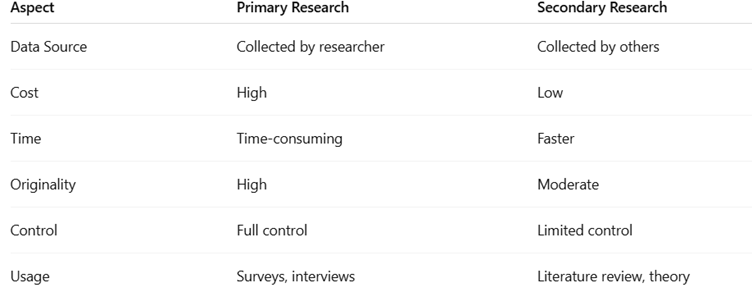
“Figure: Difference between Primary and Secondary Research”
When Should Students Use Primary Research?
- When conducting dissertations or theses
- Exploring new or under-researched topics
- When the university requires original data collection
- If you need real-world insights
When Should Students Use Secondary Research?
Secondary risk should be undertaken only when:
- Writing literature reviews
- Analysing existing theories and frameworks
- Time or resources are limited
- Conducting theoretical or conceptual studies
Can students combine both primary and secondary research
Yes, it is considered one of the most effective academic approaches
Mixed-Method Research
- Secondary research → builds theoretical foundation
- Primary research → validates theory with real data
Most high-scoring MBA projects, PhD theses, and journal papers use a combination of both.
Common Mistakes Students Should Avoid
- Using unreliable websites
- Small or biased samples
- Poorly designed questionnaires
- Ignoring ethical approval
- Plagiarising secondary sources
Tips for getting a higher score: Using Research Methods
- Align the research method with the objectives
- Justify why you chose primary or secondary research
- Use recent, peer-reviewed sources
- Present data visually (tables, charts)
- Critically analyse—don’t just describe
Final thoughts
Understanding the methods to conduct highly engaging primary and secondary research is very significant for students to get higher grades. Primary research provides depth and originality to the research study. On the other hand, secondary research offers both context and credibility. When utilised correctly, together or individually, they strengthen the arguments in the study, showcase academic maturity, and increase the overall grades.
Mastering the above-mentioned research techniques will not only help you excel in assignments but also help in creating a strong foundation for publications, firm foundations, and professional research.