How AI is changing Education: Pros, Cons, Student and Classroom uses

Sourav Mahahjan
Dec 30, 2025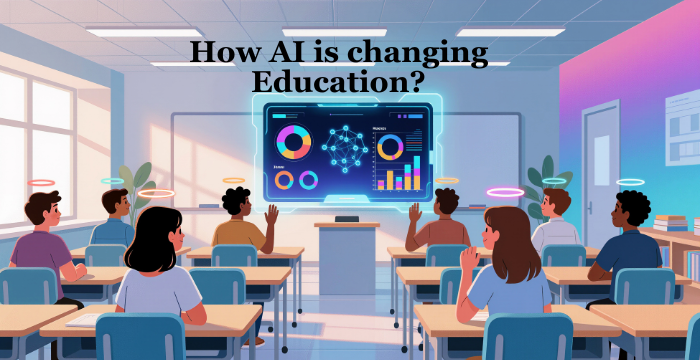
Artificial Intelligence (AI) is no longer a topic of the future; it is here and now. It is now reshaping the concept of education and altering the methods in which teachers teach students, as well as how educational institutions operate. Starting from personalised learning platforms to AI-enabled tutorial systems, the education system is undergoing a significant digital transformation that ensures inclusivity, efficiency, and innovation. Although AI has various advantages, it also raises specific critical concerns related to equity, ethics, and academic integrity.
The following blog explains how AI is transforming education, covering its issues in classrooms, benefits for teachers and students, and risks and challenges that come with AI-powered learning and education systems.
What is AI in education?
AI in the education system is the use of machine learning algorithms, data analytics, and natural language processing to improve the learning, teaching, and administrative processes. These systems help in evaluating large volumes of educational insights and data to make the learning process more efficient, student-centric, and adaptive.
Some of the popular examples are:
- Intelligent tutoring systems
- Automated grading tools
- AI chatbots for student support
- Personalised learning platforms
How AI Is Used in Classrooms Today
1. Personalised Learning Experiences
AI promotes adaptive learning, in which the content is customised on the basis of the performance, learning style, and pace of the students. Various platforms, such as AI-powered learning management systems, recommend quizzes, revision materials and lessons.
Impact:
- Students learn at their own pace
- Faster identification of learning gaps
- Improved academic outcomes
2. AI-powered Virtual assistant and Tutoring
AI chatbots and tutors enable 24/7 academic support, explaining concepts, answering questions, and guiding students with problem-solving texts.
Example of Use:
- Homework assistance
- Exam preparation
- Language learning practice
This is very helpful for the students who are confident in asking questions in a traditional classroom setting.
3. Automated Assessment and Feedback
AI tools can rank the multiple-choice questions, essays, and short answers with improved accuracy. More significantly, they promote instant feedback, assisting the students in understanding their mistakes instantly.
Advantages of the teachers:
- Reduced workload
- More time for interactive teaching
- Consistent and unbiased grading
4. Classroom analytics and management
AI-powered analytics helps the teachers in tracking the performance trends, participation and attendance. Predictive analytics can also identify the students who can fall behind.
Results:
- Early intervention
- Data-driven teaching strategies
- Better student retention

“Figure 1: Pros and Cons of AI in Education”
Benefits of AI in Education
Enhanced student engagement
The interactive tools, such as immersive simulators and gamified learning apps, make the learning process more enjoyable and engaging, especially for digital-native students.
Accessible and inclusive learning
AI plays a significant role in supporting students with disabilities with the help of
- Speech-to-text for hearing-impaired learners
- Text-to-speech for visually impaired students
- Language translation for international learners
This helps in promoting inclusivity and equity in education.
Support for teachers
In place of totally replacing the human teachers, AI work as the assistant of the teachers, completing the repetitive tasks such as scheduling and grading. This helps the educators with more essential works such as creativity, mentoring, and practising critical thinking.
Self-directing learning and lifelong
AI-based platforms promote continuous learning by providing skill recommendations,micro-courses, and career-focused learning paths, which are very important in today’s dynamically changing job market.
Student Use of AI in learning
Students are actively making use of AI tools for
- Research and information summarisation
- Grammar correction and Writing assistance
- Coding support and problem-solving
- Exam preparation and mock tests
When AI is used ethically by the students, it helps them learn smarter and not work harder.
Challenges and Risks of AI in Education
Plagiarism and academic integrity
AI-generated content raises concerns about plagiarism, cheating, and originality. Without proper guidelines, it can result in misuse by students instead of developing their skills.
Over-dependence on technology
Excessive dependence on AI tools can result in weakening creativity, critical thinking, and problem-solving capabilities when not balanced with existing traditional methods.
Security and Data Privacy
The AI systems collect a large amount of data. Therefore, poor data governance can result in
- Privacy breaches
- Misuse of personal information
- Lack of transparency in decision-making
Accessibility Issues and Digital Divide
Not every student has equal access to AI tools, devices and high-speed internet. This can increase the gap in the present educational inequalities, especially in developing countries.
Ethical Use of AI in Education
To promote ethical adoption of AI, educational and learning institutions should focus on
- Clear AI usage policies
- Plagiarism awareness and academic honesty
- Human oversight in AI decision-making
- Transparency in algorithms and data usage
AI should support continuous learning and not replace human judgment.
The future of AI in education
The future educational classrooms will most likely be a hybrid model, combining human teaching expertise with AI-driven insights. Emerging trends include:
- AI-powered virtual reality classrooms
- Emotion-aware learning systems
- Predictive career guidance tools
- Fully adaptive curricula
With the development of AI, students, policymakers, and educators should collaborate to gain the full benefits of AI while also mitigating the risks.
Final thoughts
AI is totally changing education by making the learning process more efficient, accessible, and teachers. It also requires ethical awareness, responsible, and balanced integration.
The key questions are not about is AI is useful for education, but how they are selected and used.
When implemented successfully, AI has the potential to provide a more engaging, inclusive, and future-ready educational technology.