Ethical Use of AI: What Plagiarism, Copyright, and Originality Really Mean Today

Sourav Mahahjan
Dec 19, 2025
Artificial Intelligence (AI) has totally changed the way we write, code, design, and research content. Starting from AI-generated blogs and marketing copies to art, music, and academic assistance, different types of AI tools such as Midjourney, CHATGPT, and Copilot are totally changing the creativity at a very high pace. Although this rapid adoption of AI tools has given rise to a significant question: “What does ethical use of AI really mean—especially when considering plagiarism, copyright, and originality?”
In today’s AI age, the conventional dimensions of ownership and authorship have totally changed. Therefore, understanding these new concepts is not just an option, but a basic requirement for researchers, businesspeople, marketers, students, and creators.
Understanding ethical use of AI in content creation
AI ethical usage is the transparent, lawful, and responsible application of AI technologies without misleading the audience, compromising creative and academic integrity, and violating intellectual property rights. As the AI tools are very powerful assistants, they did not replace the originality, human judgment, and accountability.
The ethical usage of AI includes
- Proper disclosure and attribution
- Avoiding misinterpretations and misuse.
- Abiding by the intellectual property laws.
- Maintaining authenticity and originality
The significant confusion arises when the AI-generated content is considered fully plagiarism-free and original by default, which is not the case every time.
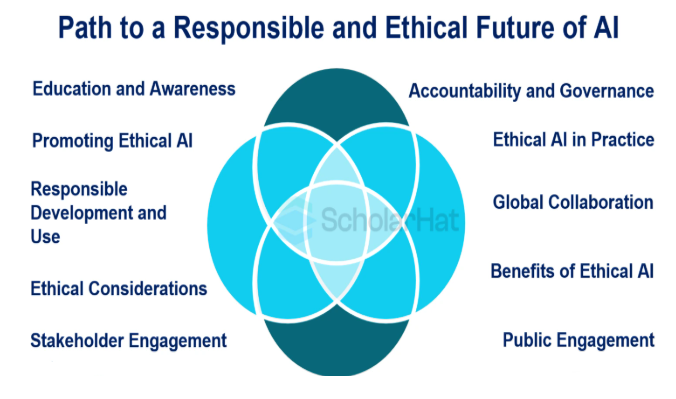
“Figure: Path to responsible and Ethical future use of AI”
Plagiarism in the AI age: A new Grey Area
Generally, plagiarism means copying the content written by someone else without giving them proper credit. The development of AI has made plagiarism very complex.
AI tools create content by analysing the patterns from a large number of existing databases of texts, and not copying it directly from there. Although ethical considerations come when
- The outputs of AI show close similarity with the published literature works.
- The user claims that the AI-generated content is entirely their own creation.
- AI is used to bypass professional and academic integrity.
Is generated content plagiarism?
In technical terms, AI does not “copy-paste”.However, ethical plagiarism occurs when the user does not add original text, content, proper acknowledgement, and critical thinking. Many publishers and universities have started classifying undisclosed AI as an act of academic misconduct.
Best Practice:
It is advisable to use AI as an ideation pr drafting tool, and not as an author for creating the final tool. It is always essential to personalise, revise and contextualise the AI-generated output.
Copyright Challenge: Who owns AI-generated Content?
Copyright law has been designed for human creators and not for machines. This has resulted in large-scale legal uncertainty.
Major copyright Questions
- Who has the ownership of the AI-generated content: the developer, the user, or no one?
- Can AI-generated content be copyrighted?
- Is training the AI tools on copyrighted content legal?
In various jurisdictions, copyright protection is linked to human ownership. This means
- Fully AI-generated text or content can be copyrighted or legally protected.
- The presence of human involvement, such as structuring, editing, and creativity, enhances the ownership claims.
- Integrated AI-generated images, music, or text commercially can contain legal risks.
Various lawsuits related to writers, artists, and different AI companies highlight the need for more explicit norms and rules.
Practical Tip:
For published or commercial work, it is essential to include meaningful human contribution and review platform-related usage credit.
Redefinition of Originality: Machine assistance vs human creativity
In today’s modern age, “tin “does not mean creating content in isolation. It includes adding the required unique human value. The AAI tools can generate a large number of ideas; however, they fail in
- Apply lived experience
- Demonstrate emotional intelligence
- Offer ethical reasoning
- Contextualise knowledge meaningfully
True originality is present in how
- Interpret AI-generated insights
- Combine ideas in novel ways
- Add critical analysis and perspective
Ethical Originality Checklist:
- Did you refine and modify the AI output?
- Did you add personal or professional insights?
- Did you verify facts and references?
- Are you transparent about AI assistance where required?
If the answer is yes, then in that case, you are using AI ethically.
Disclosure and transparency: A growing expectation
Transparency has emerged as very important in the ethical usage of AI. A large number of organisations and institutions now demand disclosure as AI tools are used.
Some of the significant examples
- Academic papers acknowledging AI assistance
- Marketing content reviewed and edited by humans
- Newsrooms are limiting AI to research and summaries
Increasing the transparency results in improving the credibility, accountability, and transparency, the central pillars of digital practice.
Ethical usage of AI in business, media, and academia
In education
- AI should promote learning, not replace it
- Students must use AI for brainstorming or grammar support
- Submitting AI-generated work without disclosure is unethical
In marketing and business
- AI content must align with the brand voice and accuracy
- Plagiarism checks and legal review are essential
- Ethical use enhances credibility, not shortcuts
In creative industries
- Artists and writers must protect their intellectual identity
- AI should be a collaborator, not a substitute
- Human creativity remains the core value
Best practices for ethical usage of AI in content creation
- Use AI as a tool, not an author
- Always edit, personalise, and fact-check outputs
- Avoid copying AI responses verbatim
- Disclose AI use where required
- Respect copyright and licensing policies
- Run plagiarism checks before publishing
- Stay updated with evolving AI regulations
All these practices protect both the audience and the creators
The future of Ethics in AI-based creativity
With the integration of AI in daily routine work, the ethical frameworks are continuously evolving. The educational institutes, governments and industries are actively working on
- AI governance policies
- Clear copyright regulations
- Ethical AI standards
The future is not about selecting between AI and humans but how successfully we integrate both of them.
Final thoughts
The ethical use of AI is not about restrictions, but rather about responsibility. Copyright, Plagiarism, and originality are still important; however, their definitions have expanded. Although AI is a powerful tool, human accountability, creativity, and integrity remain irreplaceable.
People who understand and respect the ethical use of AI will mitigate academic and legal risks and also emerge as forward-thinking and trustworthy creators in a rapidly changing digital world.