College Assignment Heading Format Every Student Must Know

Sourav Mahahjan
Jan 27, 2026
Submitting your college assignment is more than just strong content. Presentations also play a significant role in the submission process. One of the most common reasons for getting low marks is inconsistent and incorrect heading formatting. Professors generally praise assignments that follow a well-structured academic style, and headings play a significant role in guiding readers through your work.
Whether you are a postgraduate or undergraduate student, understanding and mastering the correct college assignment heading format can enhance professionalism, clarity, and academic performance. The following blog will break down everything a student should know in an efficient, simple, and easy-to-follow way.
Importance of Assignment heading formats
Headings are more than title justifiers. They
- Boost flow and readability
- Assist examiners in finding significant portions fast
- Exhibit professionalism and academic discipline.
- Show that you are aware of formal writing conventions.
- Make ideas more logically organised.
A poorly formatted assignment heading can make academically sound references appear disorganised and messy. On the other hand, the presence of structured headings can also enhance the average content.
Standard Assignment Structure for College
Before beginning formatting the headings, it is essential to understand the basic structures accepted by the colleges.
1. Title Page
2. Introduction
3. Main Body (Multiple Headings & Subheadings)
4. Conclusion
5. References / Bibliography
6. Appendices (if applicable)
Each of the sections has its own specific heading style, which will be explained as we move ahead.
Main Heading Format (Level 1 Headings)
Main headings consist of the significant sections of the assignments.
Format
- Font size: 14–16 pt
- Font style: Bold
- Alignment: Cantered or Left-aligned (check university guidelines)
- Capitalisation: Title Case
- Spacing: One blank line before and after
Examples
- Introduction
- Literature Review
- Research Methodology
- Conclusion
Note: It is advisable to avoid underlining or decorative fonts.
Subheading Format (Level 2 Headings)
The subheadings play a significant role in breaking the main sections into different thematic parts.
Format
- Font size: 12–14 pt
- Font style: Bold
- Alignment: Left-aligned
- Capitalisation: Title Case
- Spacing: One line before, no extra line after
Examples
- Impact of Social Media on Students
- Sampling Techniques Used
- Limitations of the Study
Subheadings play a significant role in enhancing the clarity of the work and help the examiners to follow the arguments.
Sub-Subheading Format (Level 3 Headings)
The section is only used; it needs further division
Format
- Font size: 12 pt
- Font style: Bold + Italic
- Alignment: Left-aligned
- Ends with: No punctuation
Examples
- Primary Data Collection Methods
- Ethical Considerations in Research
Level 3 headings should be used very cautiously, as overuse can clutter the assignment.
APA, MLA, and Harvard Heading Formats (Quick Overview)
Different types of colleges and institutions follow different referencing styles, which also impact the heading format.
APA Style (Most Common)
- Level 1: Centred, Bold
- Level 2: Left-aligned, Bold
- Level 3: Left-aligned, Bold Italic
MLA Style
- Usually, fewer heading levels
- Clear, bold headings
- Consistent formatting throughout
Harvard Style
- Similar to APA
- Focus on clarity and consistency
Tip: It is advisable to check the assignment brief file before starting to format correctly.
Unnumbered Headings vs Numbered Headings
Unnumbered Headings
Used in:
- Essays
- Humanities assignments
- Short reports
Numbered Headings
Generally used in:
- Technical reports
- Research dissertations
- Engineering or management assignments
Pro tip: Always choose the style as recommended by the lecturer. Do not mix them
Common mistakes made by the students
Some of the most frequently made mistakes are
- Using different fonts for headings
- Inconsistent font sizes
- Writing headings in ALL CAPS
- Overusing subheadings
- Adding decorative lines or colours
- Forgetting spacing consistency
Although the errors look minor, they can result in a mark deduction.
Tips for incorporating perfect headings in the assignments
Use the Styles function of your word processor.
Keep the distance constant throughout
Keep headlines brief and informative.
Align headings with the work's goals.
Before submitting, proofread the formatting.
Pro Tip: Properly heading the formatting helps pass the assignment when checked with AI-driven or plagiarism tools.
Importance of correct heading formats in improving grades
A majority of students underestimate formatting; however, professors take it very seriously, as it indicates:
- Structured thinking
- Clear presentation
- Academic discipline
Also, formatted headings demonstrate that you:
- Recognise academic norms
- Adhere to the submission requirements
- You’ve arranged your ideas logically.
This results in improved evaluation and greater marks.
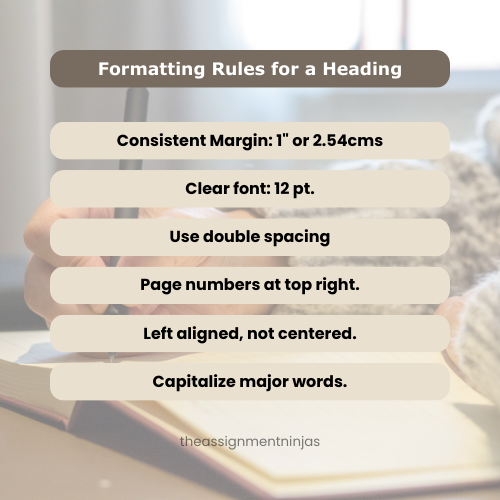
“Figure1: Basic Format for heading”
Sample Assignment Heading Format (Example)
Introduction
Brief overview of the objectives and the topic.
Literature Review
Previous Studies on the Topic
Key Findings from Existing Research
Research Methodology
Research Design
Data Collection Techniques
Results and Discussion
Conclusion
References
Final Thoughts
Understanding and mastering the heading format for college assignments is a powerful yet simple method to enhance academic performance. Poor quality formatting can reduce the impact of the research study.
Following the heading hierarchy correctly, adhering to the university’s guidelines, and ensuring consistency can make assignments look readable, examiner-friendly, and professional.
Pro Tip: Bookmark this blog, use it as a checklist, and share it with your friends before every assignment submission, and your grades will always say you “Thank You”.